A Savior Is Born a Promise Fulfilled Clip Art
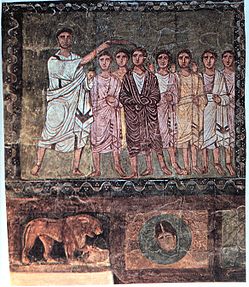
In Abrahamic religions, a messiah or messias (Hebrew: מָשִׁיחַ, romanized: māšīyaḥ ; Greek: μεσσίας, messías ; Arabic: مسيح, masîḥ ; lit. 'the anointed one') is a saviour or liberator of a group of people. The concepts of mashiach, messianism, and of a Messianic Historic period originated in Judaism,[1] [2] and in the Hebrew Bible, in which a mashiach is a king or High Priest traditionally anointed with holy anointing oil. Messiahs were non exclusively Jewish, however, and the concept of 'the' Messiah as a unmarried private is a strictly mail-Biblical tradition as information technology is not constitute in the Onetime Testament.[ii]
Ha-mashiach ( המשיח , 'the Messiah'),[iii] [a] ofttimes referred to as melekh mashiach ( מלך המשיח , 'Rex Messiah'),[five] is to exist a Jewish leader, physically descended from the paternal Davidic line through King David and King Solomon. He is thought to achieve predetermined things in a future arrival, including the unification of the tribes of Israel,[6] the gathering of all Jews to Eretz Israel, the rebuilding of the Temple in Jerusalem, the ushering in of a Messianic Age of global universal peace,[7] and the annunciation of the world to come up.[1] [2]
The Greek translation of Messiah is Khristós ( Χριστός ),[eight] anglicized as Christ. Christians commonly refer to Jesus of Nazareth as either the "Christ" or the "Messiah", assertive that the messianic prophecies were fulfilled in the mission, expiry, and resurrection of Jesus and that he volition return to fulfill the rest of messianic prophecies. Moreover, unlike the Judaic concept of the Messiah, Jesus Christ is additionally considered by Christians to exist the Son of God.
In Islam, Jesus (Arabic: عيسى, romanized: Isa ) is held to have been a prophet and the Messiah sent to the Israelites, who will return to Earth at the end of times along with the Mahdi, and defeat al-Masih advertisement-Dajjal, the false Messiah.[nine] In Ahmadiyya theology, these prophecies concerning the Mahdi and the second coming of Jesus are believed to accept been fulfilled in Mirza Ghulam Ahmad (1835–1908),[ten] the founder of the Ahmadiyya Motion, wherein the terms Messiah and Mahdi are synonyms for one and the same person.[11]
In Chabad messianism,[12] Yosef Yitzchak Schneersohn (r. 1920–1950), sixth Rebbe (spiritual leader) of Chabad Lubavitch, and Menachem Mendel Schneerson (1902–1994), seventh Rebbe of Chabad, are Messiah claimants.[13] [14] [15] [xvi]
Etymology [edit]
Messiah (Hebrew: מָשִׁיחַ , mašíaḥ , or המשיח , mashiach; Aramaic: משיחא; Classical Syriac: ܡܫܺܝܚܳܐ, Məšîḥā ; Latin: Messias) literally means 'anointed one'.[17]
In Hebrew, the Messiah is oft referred to every bit melekh mashiach ( מלך המשיח ; Tiberian: Meleḵ ha-Mašīaḥ , pronounced [ˈmeleχ hamaˈʃiaħ]), literally meaning 'the Anointed King'. The Greek Septuagint version of the Old Testament renders all 39 instances of the Hebrew mašíaḥ as Khristós ( Χριστός ).[eight] The New Attestation records the Greek transliteration Messias ( Μεσσίας ) twice in John.[Jn. 1:41] [four:25]
al-Masīḥ (Standard arabic: المسيح, pronounced [maˈsiːħ], lit. 'the anointed', 'the traveller', or 'one who cures by caressing') is the Arabic word for messiah used past both Arab Christians and Muslims. In modern Standard arabic, information technology is used every bit one of the many titles of Jesus, referred to as Yasūʿ al-Masih ( يسوع المسيح ) by Arab Christians and Īsā al-Masīḥ ( عيسى المسيح ) past Muslims.[18]
Judaism [edit]
The literal translation of the Hebrew word mashiach ( המשיח , messiah), is 'anointed', which refers to a ritual of consecrating someone or something by putting holy oil upon it. It is used throughout the Hebrew Bible in reference to a wide variety of individuals and objects; for example, kings, priests and prophets, the altar in the Temple, vessels, unleavened bread, and even a non-Jewish male monarch (Cyrus the Corking).[19]
In Jewish eschatology, the term came to refer to a hereafter Jewish king from the Davidic line, who will be "anointed" with holy anointing oil, to exist king of God'due south kingdom, and rule the Jewish people during the Messianic Age. In Judaism, the Messiah is not considered to be God or a pre-existent divine Son of God. He is considered to be a swell political leader that has descended from Male monarch David, hence why he is referred to as Messiah ben David, 'Messiah, son of David'. In Judaism, the messiah is considered to be a great, charismatic leader that is well oriented with the laws that are followed in Judaism.[20] He will be the 1 who will not "judge past what his eyes encounter" or "decide by what his ears hear."[21]
Belief in the eventual coming of a futurity messiah is a primal part of Judaism, and is one of Maimonides' 13 Principles of Organized religion.[22] Maimonides describes the identity of the Messiah in the post-obit terms:
And if a king shall ascend from amongst the House of David, studying Torah and occupied with commandments like his male parent David, according to the written and oral Torah, and he will impel all of State of israel to follow it and to strengthen breaches in its observance, and will fight God's wars, this one is to be treated as if he were the anointed one. If he succeeded and congenital the Holy Temple in its proper identify and gathered the dispersed ones of Israel together, this is indeed the anointed one for certain, and he will mend the entire world to worship the Lord together, as it is stated: "For then I shall turn for the nations a clear tongue, so that they volition all proclaim the Proper noun of the Lord, and to worship Him with a united resolve (Zephaniah 3:9)."[23]
Even though the eventual coming of the messiah is a strongly upheld belief in Judaism, trying to predict the bodily time when the messiah will come is an act that is frowned upon. These kinds of actions are thought to weaken the faith the people take in the organized religion. So in Judaism, there is no specific time when the messiah comes. Rather, it is the acts of the people that determines when the messiah comes. It is said that the messiah would come either when the world needs his coming the most (when the earth is so sinful and in desperate demand of saving by the messiah) or deserves information technology the most (when genuine goodness prevails in the globe).[22]
A common modern rabbinic interpretation is that there is a potential messiah in every generation. The Talmud, which frequently uses stories to brand a moral indicate (aggadah), tells of a highly respected rabbi who found the Messiah at the gates of Rome and asked him, "When will you finally come?" He was quite surprised when he was told, "Today." Overjoyed and total of anticipation, the human being waited all twenty-four hour period. The next day he returned, disappointed and puzzled, and asked, "You said messiah would come 'today' only he didn't come! What happened?" The Messiah replied, "Scripture says, 'Today, if you will but hearken to his phonation.'"[24]
A Kabbalistic tradition within Judaism is that the commonly discussed messiah who will usher in a period of freedom and peace, Messiah ben David, will exist preceded by Messiah ben Joseph, who volition gather the children of Israel around him, atomic number 82 them to Jerusalem. After overcoming the hostile powers in Jerusalem, Messiah ben Joseph, volition reestablish the Temple-worship and set up his ain dominion. So Armilus, according to ane group of sources, or Gog and Magog, co-ordinate to the other, will appear with their hosts earlier Jerusalem, wage war confronting Messiah ben Joseph, and slay him. His corpse, according to one group, will lie unburied in the streets of Jerusalem; according to the other, it will exist hidden by the angels with the bodies of the Patriarchs, until Messiah ben David comes and brings him back to life.[25]
Chabad [edit]
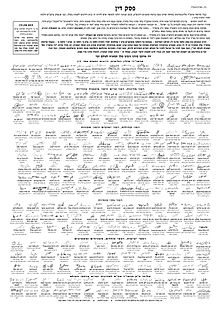
Chabad Halachic ruling declaring "every unmarried Jew" had to believe in the imminent 2d coming of the deceased 7th Lubavitcher Rebbe as the Messiah[26]
Yosef Yitzchak Schneersohn (r. 1920–1950), sixth Rebbe (spiritual leader) of Chabad Lubavitch,[27] [28] and Menachem Mendel Schneerson (1902–1994), seventh Rebbe of Chabad,[thirteen] [14] [xv] [xvi] [29] are messiah claimants.[30] [31] [32] [33] [27] [28] [34]
As per Chabad-Lubavitch messianism,[12] Menachem Mendel Schneerson openly declared his deceased father-in-police, the sometime 6th Rebbe of Chabad Lubavitch, to be the Messiah.[27] [28] He published almost Yosef Yitzchak Schneersohn to be "Atzmus u'mehus alein six er lid zich areingeshtalt in a guf" (Yiddish and English for: "Essence and Beingness [of God] which has placed itself in a trunk").[35] [36] [37] The gravesite of his deceased begetter-in-law Yosef Yitzchak Schneersohn, known as "the Ohel", became a key point of focus for Menachem Mendel Schneerson's prayers and supplications.
Regarding the deceased Menachem Mendel Schneerson, a afterwards Chabad Halachic ruling claims that information technology was "incumbent on every single Jew to mind the Rebbe'southward words and believe that he is indeed King Moshiach, who volition be revealed imminently".[26] [38] Exterior of Chabad messianism, in Judaism, there is no ground to these claims.[27] [28] If anything, this resembles the religion in the resurrection of Jesus and his 2nd coming in early Christianity.[39]
Still today, the deceased rabbi Menachem Mendel Schneerson is believed to exist the Messiah amid adherents of the Chabad movement,[14] [15] [sixteen] [31] [33] and his second coming is believed to be imminent.[26] He is venerated and invocated to by thousands of visitors and letters each yr at the (Ohel), peculiarly in a pilgrimage each twelvemonth on the anniversary of his death.[40] [41]
Christianity [edit]
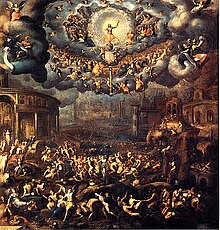
Originating from the concept in Judaism, the Messiah in Christianity is called the Christ—from Greek khristós ( χριστός ), translating the Hebrew discussion of the aforementioned pregnant.[8] 'Christ' became the accepted Christian designation and title of Jesus of Nazareth, as Christians believe that the messianic prophecies in the Old Attestation—that he is descended from the Davidic line, and was declared King of the Jews—were fulfilled in his mission, death, and resurrection, while the residuum of the prophecies—that he will usher in a Messianic Age and the earth to come—will be fulfilled at his Second Coming. Some Christian denominations, such as Catholicism, instead believe in amillenialist theology, but the Cosmic Church has not adopted this term.[42]
The bulk of historical and mainline Christian theologies consider Jesus to be the Son of God and God the Son, a concept of the messiah fundamentally different from the Jewish and Islamic concepts. In each of the four New Testament Gospels, the only literal anointing of Jesus is conducted past a woman. In the Gospels of Mark, Matthew, and John, this anointing occurs in Bethany, exterior Jerusalem. In the Gospel of Luke, the anointing scene takes place at an indeterminate location, but the context suggests information technology to exist in Galilee, or even a divide anointing altogether.
Aside from Jesus, the Book of Isaiah refers to Cyrus the Slap-up, male monarch of the Achaemenid Empire, as a messiah for his prescript to rebuild the Jerusalem Temple.[43]
Islam [edit]

Timeline of Jesus in Islamic Eschatology
The Islamic faith uses the Arabic term al-Masīḥ ( المسيح , pronounced [maˈsiːħ]) to refer to Jesus. Even so the pregnant is dissimilar from that found in Christianity and Judaism:
Though Islam shares many of the beliefs and characteristics of the ii Semitic/Abrahamic/monotheistic religions which preceded it, the idea of messianism, which is of primal importance in Judaism and Christianity, is alien to Islam as represented by the Qur'an.[44]
The Quran states that Jesus (Isa), the son of Maryam (Isa ibn Maryam), is the messiah (al-masih) and prophet sent to the Children of State of israel.[45] According to Qadi al-Nu'man, a famous Muslim jurist of the Fatimid menses, the Quran identifies Jesus as the messiah considering he was sent to the people who responded to him in society to remove (masaha) their impurities, the ailments of their faith, whether apparent ( zāhir ) or hidden ( bātin ).[46]
Jesus is one of the most important prophets in the Islamic tradition, forth with Noah, Abraham, Moses, and Muhammad.[47] [48] Unlike Christians, Muslims see Jesus as a prophet, just not as God himself or the son of God. This is because prophecy in human course does not represent the truthful powers of God, contrary to the pop delineation of Jesus in Christianity.[49] Thus, like all other Islamic prophets, Jesus is one of the grand prophets who receives revelations from God.[50] According to religious scholar Mona Siddiqui, in Islam, "[p]rophecy allows God to remain veiled and there is no proposition in the Qur'an that God wishes to reveal of himself just nevertheless. Prophets guarantee interpretation of revelation and that God'south bulletin volition exist understood."[49]In Sura nineteen, the Quran describes the nascence of Isa,[51] and sura 4 explicitly states Isa as the Son of Maryam.[52] Sunni Muslims believe Isa is alive in Heaven and did not die in the crucifixion. Sura 4, verses 157–158, also states that:
Merely they neither killed nor crucified him—information technology was only made to appear so.[53]
According to religious scholar Mahmoud Ayoub, "Jesus' close proximity or nearness (qurb) to God is affirmed in the Qur'anic insistence that Jesus did not die, but was taken upwards to God and remains with God."[54] [55]
While the Quran does not land that he will come dorsum,[48] Islamic tradition nevertheless believes that Jesus will return at the end of times, shortly preceding Mahdi, and exercise his power of healing.[9] [56] He will forever destroy the falsehood embodied in al-Masih ad-Dajjal (the faux Messiah), the smashing falsifier, a effigy similar to the Antichrist in Christianity, who volition emerge shortly before Yawm al-Qiyāmah ('the Twenty-four hours of Resurrection').[9] [55] Afterward he has destroyed ad-Dajjal, his last job volition be to become leader of the Muslims. Isa will unify the Muslim Ummah (the followers of Islam) under the mutual purpose of worshipping Allah lonely in pure Islam, thereby catastrophe divisions and deviations past adherents. Mainstream Muslims believe that at that time, Isa will dispel Christian and Jewish claims nigh him.
A hadith in Abu Dawud says:
The Prophet said: There is no prophet me and him, that is, Isa. He will descend (to the earth). When you meet him, recognise him: a human of medium peak, reddish fair, wearing two light yellow garments, looking as if drops were falling down from his caput though it will not exist wet. He volition fight the people for the cause of Islam. He will intermission the cross, kill swine, and abolish jizyah. Allah will perish all religions except Islam. He will destroy the Antichrist and will live on the earth for twoscore years so he will dice. The Muslims will pray over him.
—Hadith[57]
Both Sunni[48] and Shia Muslims concord[58] that al-Mahdi will make it offset, and afterward him, Isa. Isa will proclaim al-Mahdi as the Islamic community leader. A state of war will be fought—the Dajjal confronting al-Mahdi and Isa. This war volition marking the approach of the coming of the Concluding Day. After Isa slays al-Dajjāl at the Gate of Lud, he will show and reveal that Islam is indeed the true and last word from God to humanity as Yusuf Ali's translation reads:
And there is none of the People of the Book only must believe in him before his death; and on the Mean solar day of Judgment he will exist a witness against them.[59]
A hadith in Sahih Bukhari[lx] says:
Allah's Apostle said, "How will you exist when the son of Mariam descends among y'all and your Imam is from among y'all?"
The Quran denies the crucifixion of Jesus,[48] claiming that he was neither killed nor crucified.[61] The Quran as well emphasizes the difference between Allah and the Messiah:[62]
Those who say that Allah is the Messiah, son of Mary, are unbelievers. The Messiah said: "O Children of Israel, worship Allah, my Lord and your Lord... unbelievers also are those who have said that Allah is the third of three... the Messiah, son of Mary, was only a Messenger before whom other Messengers had gone.
Shia Islam [edit]
The Twelver branch of Shia (or Shi'i) Islam, which significantly values and revolves effectually the Twelve Imams (spiritual leaders), differs significantly from the behavior of Sunni Islam. Different Sunni Islam, "Messianism is an essential role of religious belief and practice for almost all Shi'a Muslims."[44] Shi'i Islam believes that the last Imam will return once more, with the return of Jesus. Co-ordinate to religious scholar Mona Siddiqui, "Shi'is are acutely aware of the beingness everywhere of the 12th Imam, who disappeared in 874."[49] Shi'i piety teaches that the subconscious Imam volition return with Jesus Christ to ready the messianic kingdom before the last Judgement Day, when all humanity volition stand before God. There is some controversy every bit to the identity of this imam. At that place are sources that underscore how the Shia sect agrees with the Jews and Christians that Imam Mehdi (al-Mahdi) is another name for Elijah, whose return prior to the inflow of the Messiah was prophesied in the Old Testament.[63]
The Imams and Fatima will have a direct touch on the judgements rendered that 24-hour interval, representing the ultimate intercession.[64] There is fence on whether Shi'i Muslims should take the death of Jesus. Religious scholar Mahmoud Ayoub argues "Mod Shi'i thinkers take immune the possibility that Jesus died and but his spirit was taken up to heaven."[55] Conversely, Siddiqui argues that Shi'i thinkers believe Jesus was "neither crucified nor slain."[49] She also argues that Shi'i Muslims believe that the twelfth imam did not die, just "was taken to God to return in God'southward time," and "will return at the end of history to institute the kingdom of God on globe as the expected Mahdi."[49]
Ahmadiyya [edit]

Mirza Ghulam Ahmad, founder of the Ahmadiyya Movement in Islam, considered by Ahmadis to be the Promised Messiah of the latter days
In the theology of Ahmadiyya, the terms Messiah and Mahdi are synonymous terms for one and the same person.[xi] The term Mahdi ways 'guided [by God]', thus implying a directly ordainment by God of a divinely chosen individual.[65] According to Ahmadi idea, Messiahship is a miracle through which a special accent is given on the transformation of a people by style of offering to suffer for the sake of God instead of giving suffering (i.east. refraining from revenge).[ citation needed ] Ahmadis believe that this special emphasis was given through the person of Jesus and Mirza Ghulam Ahmad (1835–1908)[10] amidst others.
Ahmadis concord that the prophesied eschatological figures of Christianity and Islam, the Messiah and Mahdi, were, in fact, to be fulfilled in ane person who was to represent all previous prophets.[54]
Numerous hadith are presented by the Ahmadis in support of their view, such equally one from Sunan Ibn Majah, which says, "At that place is No Mahdi other than Jesus son of Mary."[66]
Ahmadis believe that the prophecies concerning the Mahdi and the second coming of Jesus take been fulfilled in Mirza Ghulam Ahmad (1835–1908), the founder of the Ahmadiyya Movement. Unlike mainstream Muslims, the Ahmadis do not believe that Jesus is alive in sky, but that he survived the crucifixion and migrated towards the east where he died a natural death and that Ghulam Ahmad was only the promised spiritual second coming and likeness of Jesus, the promised Messiah and Mahdi.[67] He also claimed to have appeared in the likeness of Krishna and that his advent fulfilled certain prophecies found in Hindu scriptures.[68] He stated that the founder of Sikhism was a Muslim saint, who was a reflection of the religious challenges he perceived to be occurring.[69] Ghulam Ahmad wrote Barahin-due east-Ahmadiyya, in 1880, which incorporated Indian, Sufi, Islamic and Western aspects in order to give life to Islam in the face of the British Raj, Protestant Christianity, and rising Hinduism. He later declared himself the Promised Messiah and the Mahdi following Divine revelations in 1891. Ghulam Ahmad argued that Jesus had appeared 1300 years after the formation of the Muslim customs and stressed the need for a current Messiah, in plough claiming that he himself embodied both the Mahdi and the Messiah. Ghulam Ahmad was supported by Muslims who especially felt oppressed by Christian and Hindu missionaries.[69]
Druze religion [edit]
In the Druze religion, Jesus is considered the Messiah and i of God's of import prophets,[seventy] [71] being among the seven prophets who appeared in different periods of history.[70] [71] According to the Druze manuscripts Jesus is the Greatest Imam and the incarnation of Ultimate Reason (Akl) on earth and the first cosmic principle (Hadd),[72] and regards Jesus and Hamza ibn Ali as the incarnations of one of the five great angelic powers, who form part of their arrangement.[73] Druze doctrines include the behavior that Jesus was born of a virgin named Mary, performed miracles, and died by crucifixion.[72]
Druze believe that Hamza ibn Ali was a reincarnation of Jesus,[74] and that Hamza ibn Ali is the truthful Messiah, who directed the deeds of the messiah Jesus "the son of Joseph and Mary", just when messiah Jesus "the son of Joseph and Mary" strayed from the path of the true Messiah, Hamza filled the hearts of the Jews with hatred for him - and for that reason, they crucified him, according to the Druze manuscripts.[72] [75] Despite this, Hamza ibn Ali took him down from the cantankerous and allowed him to return to his family, in order to prepare men for the preaching of his faith.[72]
Other religions [edit]
- In Buddhism, Maitreya is considered to the next Buddha (awakened one) that is promised to come. He is expected to come to renew the laws of Buddhism once the teaching of Gautama Buddha has completely rust-covered.[76]
- Mírzá Ḥusayn-ʻAlí Núrí, founder of the Baháʼí Faith, claimed to be "He whom God will make manifest" of the Babi religion.[77] His title Bahá'u'lláh, when translated literally, means "The Celebrity of God" in Arabic. According to the Baháʼí Faith, Bahá'u'lláh addressed not only those timeless theological and philosophical questions that have stayed with humanity since old times such as: Who is God? What is goodness? and Why are we here? but besides the questions that have preoccupied philosophers of the 20th century: What motivates human nature? Is real peace indeed possible? Does God nonetheless intendance for humanity? and the similar.[78] He taught that there is simply one God, that all of the world's religions are from God, and that now is the time for humanity to recognize its oneness and unite.[79]
- Emperor Haile Selassie I of Federal democratic republic of ethiopia is believed to exist the Messiah by followers of the Rastafari motility.[eighty] This idea further supports the conventionalities that God himself is blackness, which they (followers of the Rastafarian motility) attempt to further strengthen by a verse from the Bible.[Jeremiah 8:21] Even if the Emperor denied existence the messiah, the followers of the Rastafari movement believe that he is a messenger from God. To justify this, Rastafarians used reasons such every bit Emperor Haile Selassie's bloodline, which is assumed to come up from Male monarch Solomon of Israel, and the various titles given to him, which include Lord of Lords, King of Kings and Acquisition Lion of the tribe of Judah.[81]
- In Kebatinan (Javanese religious tradition), Satrio Piningit is a character in Jayabaya's prophecies who is destined to get a great leader of Nusantara and to rule the globe from Java. In Serat Pararaton,[82] Rex Jayabaya of Kediri foretold that before the coming of Satrio Piningit, there would be wink floods and that volcanoes would erupt without alarm. Satrio Piningit is a Krishna-like figure known every bit Ratu Adil (Indonesian: 'But King, King of Justice') and his weapon is a trishula.[83]
- In Zoroastrianism there are three messiah figures who each progressively bring about the final renovation of the globe, the Frashokereti and all of these three figures are called Saoshyant.[ citation needed ]
- In Aradia, or the Gospel of the Witches, the messiah is Aradia, daughter of the goddess Diana, who comes to Earth in society to found the exercise of witchcraft before returning to Heaven.[84]
Popular culture [edit]
- Dune Messiah, a 1969 novel past Frank Herbert, second in his Dune trilogy, also part of a miniseries, i of the widest-selling works of fiction in the 1960s.
- In the Infinity saga of Crewman Moon and the third season of the 1990s anime, the 1 who brings forth "the Silence" of total earth annihilation is called "the Messiah of Silence", namely Mistress 9 of the Expiry Busters. The iii Sailor Guardians of the Outer Planets had initially believed that to be Sailor Saturn, the final Sailor Guardian.
- Messiah is the final persona of the protagonist of Persona 3 (2006), obtained after he understands the pregnant of his journey
- The Messiah, a 2007 Persian film depicting the life of Jesus from an Islamic perspective
- The Young Messiah, a 2016 American film depicting the childhood life of Jesus from a Christian perspective
- Messiah, a 2020 American Television series.
The following works include the concept of a messiah as a leader of a cause or liberator of a people:
- The Jewish Messiah, a 2008 novel by Arnon Grunberg
- Messiah, a 1999 novel by Andrei Codrescu
See also [edit]
- Kalki, a effigy in Hindu eschatology
- Li Hong, a effigy in Taoist eschatology
- List of messiah claimants
- Jewish Messiah claimants
- List of people claimed to exist Jesus
- Listing of Mahdi claimants
- Messiah circuitous
- Saoshyant, a figure in Zoroastrianism who brings near the final renovation of the world
- Soter
- Year 6000
References [edit]
Footnotes [edit]
- ^ The specific expression ha mashiach does not occur in the Tanakh.[4]
Citations [edit]
- ^ a b Schochet, Jacob Immanuel. "Moshiach ben Yossef". Tutorial. moshiach.com. Archived from the original on 20 December 2002. Retrieved 2 Dec 2012.
- ^ a b c Blidstein, Prof. Dr. Gerald J. "Messiah in Rabbinic Idea". Messiah. Jewish Virtual Library and Encyclopaedia Judaica 2008 The Gale Group. Retrieved 2 Dec 2012.
- ^ Telushkin, Joseph. "The Messiah". The Jewish Virtual Library Jewish Literacy. NY: William Morrow and Co., 1991. Reprinted by permission of the author. Retrieved 2 December 2012.
- ^ "The Jewish Concept of Messiah and the Jewish Response to Christian Claims – Jews For Judaism". jewsforjudaism.org. Jews For Judaism. Archived from the original on 16 September 2016. Retrieved 31 August 2016.
- ^ Flusser, David. "Second Temple Period". Messiah. Encyclopaedia Judaica 2008. The Gale Group. Retrieved 2 December 2012.
- ^ Megillah 17b–18a, Taanit 8b
- ^ Sotah 9a
- ^ a b c "Etymology Online".
- ^ a b c "Muttaqun OnLine – Dajjal (The Anti-Christ): According to the Qur'an and Sunnah". Muttaqun.com. Retrieved 9 Nov 2012.
- ^ a b "Enquire Islam: What is the dissimilar between a messiah and a prophet? (sound)".
- ^ a b "Messiah and Mahdi - Review of Religions". Jan 2009.
- ^ a b also: Habad messianism, Lubavitcher messianism, mishichism, meshichism.
- ^ a b Susan Handelman, The Lubavitcher Rebbe Died twenty Years Agone Today. Who Was He?, Tablet Mag
- ^ a b c Adin Steinsaltz, My Rebbe. Maggid Books, p. 24
- ^ a b c Dara Horn, 13 June 2014 "Rebbe of Rebbe'southward". The Wall Street Journal.
- ^ a b c Aharon Lichtenstein, Euligy for the Rebbe. 16 June 1994.
- ^ "Online Etymology Dictionary".
- ^ Badawi, Elsaid; Haleem, Muhammad Abdel (2008). Arabic–English Dictionary of Qur'anic Usage. Koninklijke Brill. p. 881. ISBN9789047423775.
- ^ Tanakh verses:
- one Samuel x:i–ii
- one Kings 1:39
- Leviticus 4:3
- Exodus 40:9–11
- Numbers 6:15
- Isaiah 45:1
- ^ "Judaism 101: Mashiach: The Messiah". Jewfaq.org. Retrieved 2 May 2014.
- ^ Isaiah 11:3–four
- ^ a b "Judaism 101: Mashiach: The Messiah". Jewfaq.org. Retrieved ix November 2012.
- ^ Mishneh Torah, Laws of Kings 11:4
- ^ Psalms 95:7
- ^ "Messiah". Jewish Encyclopedia. 1906. Retrieved two May 2014.
- ^ a b c Berger, Rabbi Prof. Dr. David. "On the Spectrum of Messianic Belief in Contemporary Lubavitch Chassidism". Shema Yisrael Torah Network. Retrieved three July 2016.
- ^ a b c d Bar-Hayim, HaRav David. "The False Mashiah of Lubavitch-Habad". Machon Shilo (Shilo Plant). Archived from the original on 25 February 2011. Retrieved 17 June 2016.
- ^ a b c d Bar-Hayim, HaRav David. "Habad and Jewish Messianism (audio)". Machon Shilo (Shilo Institute). Archived from the original on nine Jan 2015. Retrieved 17 June 2016.
- ^ The New York Times, Statement From Agudas Chasidei Chabad, ix Feb 1996.
- ^ "Famed Posek Rabbi Menashe Klein: Messianic Group Within Chabad Are Apikorsim". vii May 2009.
- ^ a b On Chabad Archived 19 February 2015 at the Wayback Automobile
- ^ Public Responsa from Rabbi Aharon Feldman on the matter of Chabad messiansim (Hebrew), 23 Sivan, 5763 – http://moshiachtalk.tripod.com/feldman.pdf. See also Rabbi Feldman'southward letter to David Beger: http://www.stevens.edu/golem/llevine/feldman_berger_sm_2.jpg
- ^ a b Berger, David (2008). The Rebbe, the Messiah, and the Scandal of Orthodox Indifference. Littman Library of Jewish Culture. ISBN978-1904113751. for further data see the article: The Rebbe, the Messiah, and the Scandal of Orthodox Indifference
- ^ William Horbury, Markus Bockmuehl, James Carleton Paget: Redemption and resistance: the messianic hopes of Jews and Christians in antiquity p. 294 : (2007) ISBN 978-0567030443
- ^ Likutei Sichos, Vol 2, pp. 510–511.
- ^ Identifying Chabad : what they teach and how they influence the Torah world (Revised ed.). Illinois: Center for Torah Demographics. 2007. p. 13. ISBN978-1411642416 . Retrieved 29 June 2016.
- ^ Archived at Ghostarchive and the Wayback Machine: Singer, HaRav Tovia. "Why did some await the Lubavitcher Rebbe to Resurrect every bit the Messiah? Rabbi Tovia Vocalizer Responds (video-lecture)". Tovia Vocalist Youtube.com. Retrieved 26 June 2016.
- ^ "Halachic Ruling". Psak Din . Retrieved 22 March 2014.
- ^ Freeman, Charles. The Endmost of the Western Mind, p. 133. Vintage. 2002.
- ^ Gryvatz Copquin, Claudia (2007). The Neighborhoods of Queens. Yale University Press. pp. 20–23. ISBN978-0-300-11299-iii.
- ^ The New York Observer, "Rebbe to the city and Rebbe to the earth". Editorial, 07/08/14.
- ^ "The Rapture". Cosmic Answers . Retrieved 13 May 2020.
- ^ "Cyrus". Jewish Encyclopedia (1906). "This prophet, Cyrus, through whom were to exist redeemed His called people, whom he would glorify earlier all the world, was the promised Messiah, 'the shepherd of Yhwh' (xliv. 28, xlv. one)."
- ^ a b Hassan, Riffat (Bound 1985). "Messianism and Islam" (PDF). Periodical of Ecumenical Studies. 22:2: 263.
- ^ Quran three:45
- ^ Virani, Shafique (January 2019). "Hierohistory in Qāḍī l-Nuʿmān's Foundation of Symbolic Interpretation (Asās al-Taʾwīl): The Nativity of Jesus". Studies in Islamic Historiography: 147.
- ^ Quran 33:7 Quran 42:thirteen-14 Quran 57:26
- ^ a b c d Albert, Alexander. "Orientating, Developing, and Promoting an Islamic Christology". FIU Electronic Theses and Dissertations. Retrieved one May 2014.
- ^ a b c d e Siddiqui, Mona (2013). Christians, Muslims, and Jesus. Yale University Press. pp. 12. ISBN978-0-300-16970-6.
- ^ Wensick, A.J. (2012). "al- Masih". Encyclopedia of Islam.
- ^ Quran nineteen:i-33
- ^ Quran 4:171
- ^ Kendal, Elizabeth (2016). After Sabbatum Comes Sunday: Understanding the Christian Crunch in the Middle E. Eugene, OR: Resource Publications. p. 29. ISBN9781498239882.
- ^ a b "The Holy Quran". Alislam.org. Retrieved 9 November 2012.
- ^ a b c Ayoub, Mahmoud (2007). A Muslim View of Christianity: Essays on Dialogue. Maryknoll, NY: Orbis Books. p. 115. ISBN978-1-57075-690-0.
- ^ Khalidi, Tarif (2001). Muslim Jesus . President and Fellows of Harvard College. pp. 25. ISBN0-674-00477-9.
- ^ Sunan Abu Dawood 4324
- ^ "Sunni and Shi'a". BBC. Retrieved i May 2014.
- ^ Quran four:159
- ^ Sahih al-Bukhari 3449
- ^ Quran 4:157
- ^ Quran 5:72-77
- ^ Abbas, Muhammad (2007). Israel: The History and How Jews, Christians and Muslims Can Achieve Peace. New York: iUniverse. ISBN9780595426195.
- ^ Bill, James; Williams, John Alden (2002). Roman Catholics and Shi'i Muslims. The Academy of North Carolina Printing. pp. 57–58. ISBN0-8078-2689-8.
- ^ "mahdi"-special-meaning-and-technical-usage ""Mahdi" in a Special Meaning and Technical Usage". Ahlul Bayt Digital Islamic Library Project. Retrieved xxx April 2014.
- ^ Ibn Majah, Bab, Shahadatu-Zaman
- ^ "Jesus: A apprehensive prophet of God". Ahmadiyya Muslim Community. Retrieved xxx April 2014.
- ^ Hadrat Mirza Ghulam Ahmad of Qadian (2007). Lecture Sialkot (PDF). Tilford, Surrey, Britain: Islam International Publications Ltd. pp. 39–40. Lecture Sialkot
- ^ a b Robinson, Francis. "Prophets without honour? Ahmad and the Ahmadiyya". History Today. twoscore (June): 46.
- ^ a b Hitti, Philip Chiliad. (1928). The Origins of the Druze People and Religion: With Extracts from Their Sacred Writings. Library of Alexandria. p. 37. ISBN978-1-4655-4662-3.
- ^ a b Dana, Nissim (2008). The Druze in the Heart East: Their Faith, Leadership, Identity and Status. Michigan University press. p. 17. ISBN978-1-903900-36-ix.
- ^ a b c d Dana, Nissim (2008). The Druze in the Centre E: Their Religion, Leadership, Identity and Status. Michigan Academy printing. p. 47. ISBN978-1-903900-36-nine.
- ^ Crone, Patricia (2013). The Princeton Encyclopedia of Islamic Political Thought. Princeton University Press. p. 139. ISBN9780691134840.
- ^ South. Sorenson, David (2008). The Princeton Encyclopedia of Islamic Political Thought. Routledge. p. 239. ISBN9780429975042.
They further believe that Hamza ibn Ali was a reincarnation of many prophets, including Christ, Plato, Aristotle.
- ^ Massignon, Louis (2019). The Passion of Al-Hallaj, Mystic and Martyr of Islam, Volume 1: The Life of Al-Hallaj. Princeton Academy Press. p. 594. ISBN9780691610832.
- ^ "Maitreya (Buddhism)". Encyclopædia Britannica Online. Encyclopædia Britannica. Retrieved ii May 2014.
- ^ Momen, Moojan (2004). "Baha'i Organized religion and Holy People". In Jestice, Phyllis Yard. (ed.). Holy People of the World: A Cross-cultural Encyclopedia (PDF). Santa Barbara, CA: ABC-CLIO. p. 93. ISBN1-57607-355-6.
- ^ "Bahá'u'lláh - History". Archived from the original on 13 July 2014. Retrieved two May 2014.
- ^ "The life of Baha'u'llah". Baha'i.org. Retrieved 2 May 2014.
- ^ "Rastafarian behavior". BBC. nine October 2009. Retrieved 12 September 2010.
- ^ "Haile Selassie I - God of the Black race". BBC News . Retrieved two May 2014.
- ^ R.K. Mangkudimedja. 1979. Serat Pararaton Jilid 2. Jakarta: Departemen Pendidikan dan Kebudayaan, Proyek Penerbitan Buku Sastra Indonesia dan Daerah. p. 168 (In Indonesian)
- ^ Mulder, Niel. 1980. "Kedjawen: Tussen de Geest en Persoonlijkheid van Javaans". The Hague: Droggstopel. p. 72 (In Dutch)
- ^ Charles Godfrey Leland (1899). Aradia, or the Gospel of the Witches. D. Nutt. p. 8. Retrieved 29 December 2021.
Farther reading [edit]
- Aryeh Kaplan, From Messiah to Christ, New York: Orthodox Union, 2004.
- Joseph Klausner, The Messianic Idea in Israel from Its Beginning to the Completion of the Mishnah, London: George Allen & Unwin, 1956.
- Jacob Neusner, William S. Green, Ernst Frerichs, Judaisms and their Messiahs at the Plough of the Christian Era, Cambridge: Cambridge University Press, 1987.
External links [edit]
 | Wikiquote has quotations related to: Messiah |
- Messiah in Jewish Virtual Library
- Smith, William R.; Whitehouse, Owen C. (1911). . Encyclopædia Britannica. Vol. eighteen (11th ed.). pp. 191–194.
- Geddes, Leonard W. (1911). . In Herbermann, Charles (ed.). Catholic Encyclopedia. Vol. x. New York: Robert Appleton Visitor.
Source: https://en.wikipedia.org/wiki/Messiah
Belum ada Komentar untuk "A Savior Is Born a Promise Fulfilled Clip Art"
Posting Komentar