True or False The Upload and Download Signals for Satellites Are Transmitted at the Same Frequency

A communications satellite is an artificial satellite that relays and amplifies radio telecommunications signals via a transponder; information technology creates a communication aqueduct between a source transmitter and a receiver at dissimilar locations on Earth. Communications satellites are used for television, telephone, radio, internet, and military applications.[1] Equally of 1 January 2021, there are 2,224 communications satellites in Earth orbit.[ii] Most communications satellites are in geostationary orbit 22,300 miles (35,900 km) above the equator, and then that the satellite appears stationary at the same point in the sky; therefore the satellite dish antennas of basis stations can exist aimed permanently at that spot and do not accept to move to rail the satellite.
The high frequency radio waves used for telecommunications links travel by line of sight then are obstructed by the curve of the Earth. The purpose of communications satellites is to relay the point around the curve of the Earth assuasive communication betwixt widely separated geographical points.[iii] Communications satellites utilize a broad range of radio and microwave frequencies. To avoid indicate interference, international organizations accept regulations for which frequency ranges or "bands" certain organizations are allowed to use. This resource allotment of bands minimizes the gamble of point interference.[4]
History [edit]
Origins [edit]
In October 1945, Arthur C. Clarke published an article titled "Extraterrestrial Relays" in the British magazine Wireless World.[v] The article described the fundamentals backside the deployment of artificial satellites in geostationary orbits for the purpose of relaying radio signals. Considering of this, Arthur C. Clarke is often quoted as beingness the inventor of the concept of the communications satellite, and the term 'Clarke Belt' is employed every bit a description of the orbit.[6]

The outset bogus Earth satellite was Sputnik 1 which was put into orbit past the Soviet Union on October four, 1957. It was adult past Mikhail Tikhonravov and Sergey Korolev, edifice on work by Konstantin Tsiolkovsky.[7] Sputnik 1 was equipped with an on-board radio-transmitter that worked on two frequencies of 20.005 and 40.002 MHz, or seven and 15 meters wavelength. The satellite was not placed in orbit for the purpose of sending data from one betoken on earth to some other; the radio transmitter was meant to study the properties of radio wave distribution throughout the ionosphere. The launch of Sputnik 1 was a major step in the exploration of infinite and rocket development, and marks the starting time of the Space Historic period.[8]
Early agile and passive satellite experiments [edit]
There are 2 major classes of communications satellites, passive and active. Passive satellites simply reflect the signal coming from the source, toward the direction of the receiver. With passive satellites, the reflected signal is non amplified at the satellite, and only a very small amount of the transmitted energy actually reaches the receiver. Since the satellite is then far above Earth, the radio signal is attenuated due to free-space path loss, then the point received on Earth is very, very weak. Active satellites, on the other manus, amplify the received signal before retransmitting information technology to the receiver on the ground.[4] Passive satellites were the beginning communications satellites, but are niggling used at present.
Work that was begun in the field of electrical intelligence gathering at the United States Naval Research Laboratory in 1951 led to a project named Communication Moon Relay. Military planners had long shown considerable involvement in secure and reliable communications lines every bit a tactical necessity, and the ultimate goal of this projection was the creation of the longest communications circuit in man history, with the moon, Earth'south natural satellite, acting as a passive relay. After achieving the starting time transoceanic communication between Washington, D.C. and Hawaii on 23 Jan 1956, this system was publicly inaugurated and put into formal production in January 1960.[ix]
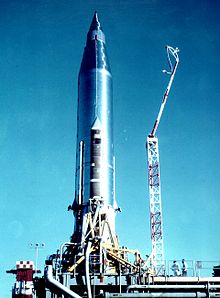
The Atlas-B with SCORE on the launch pad; the rocket (without booster engines) constituted the satellite.
The get-go satellite purpose-built to actively relay communications was Project SCORE, led by Avant-garde Research Projects Bureau (ARPA) and launched on 18 Dec 1958, which used a tape recorder to comport a stored vocalization message, likewise as to receive, store, and retransmit messages. Information technology was used to ship a Christmas greeting to the world from U.S. President Dwight D. Eisenhower. The satellite too executed several realtime transmissions before the not-rechargeable batteries failed on 30 December 1958 after 8 hours of bodily functioning.[ten] [xi]
The straight successor to SCORE was another ARPA-led project chosen Courier. Courier 1B was launched on 4 Oct 1960 to explore whether it would exist possible to constitute a global military communications network by using "delayed repeater" satellites, which receive and store data until commanded to rebroadcast them. After 17 days, a command arrangement failure ended communications from the satellite.[12] [13]
NASA'southward satellite applications programme launched the first artificial satellite used for passive relay communications in Echo 1 on 12 Baronial 1960. Echo 1 was a aluminized balloon satellite interim equally a passive reflector of microwave signals. Advice signals were bounced off the satellite from 1 point on Globe to another. This experiment sought to plant the feasibility of worldwide broadcasts of telephone, radio, and television signals.[13] [14]
More than firsts and further experiments [edit]
Telstar was the first active, straight relay communications commercial satellite and marked the offset transatlantic transmission of goggle box signals. Belonging to AT&T as part of a multi-national agreement between AT&T, Bell Telephone Laboratories, NASA, the British General Post Role, and the French National PTT (Postal service Office) to develop satellite communications, it was launched by NASA from Cape Canaveral on ten July 1962, in the commencement privately sponsored space launch.[15] [16]
Another passive relay experiment primarily intended for military communications purposes was Project West Ford, which was led by Massachusetts Institute of Technology's Lincoln Laboratory.[17] After an initial failure in 1961, a launch on 9 May 1963 dispersed 350 million copper needle dipoles to create a passive reflecting belt. Even though merely about one-half of the dipoles properly separated from each other,[18] the projection was able to successfully experiment and communicate using frequencies in the SHF Ten band spectrum.[19]
An immediate antecedent of the geostationary satellites was the Hughes Aircraft Company's Syncom 2, launched on 26 July 1963. Syncom ii was the first communications satellite in a geosynchronous orbit. It revolved effectually the earth once per day at constant speed, simply because information technology notwithstanding had north–south motion, special equipment was needed to rail it.[xx] Its successor, Syncom 3, launched on 19 July 1964, was the commencement geostationary communications satellite. Syncom 3 obtained a geosynchronous orbit, without a north–s motility, making information technology appear from the ground as a stationary object in the sky.[21]
A directly extension of the passive experiments of Project West Ford was the Lincoln Experimental Satellite program, also conducted by the Lincoln Laboratory on behalf of the The states Department of Defense.[17] The LES-1 active communications satellite was launched on 11 February 1965 to explore the feasibility of active solid-land Ten band long-range military communications. A total of ix satellites were launched betwixt 1965 and 1976 as part of this series.[22] [23]
International commercial satellite projects [edit]
In the The states, 1962 saw the creation of the Communications Satellite Corporation (COMSAT) private corporation, which was subject to pedagogy by the US Government on matters of national policy.[24] Over the side by side two years, international negotiations led to the Intelsat Agreements, which in turn led to the launch of Intelsat 1, besides known as Early on Bird, on 6 Apr 1965, and which was the first commercial communications satellite to be placed in geosynchronous orbit.[25] [26] Subsequent Intelsat launches in the 1960s provided multi-destination service and video, audio, and information service to ships at sea (Intelsat ii in 1966–67), and the completion of a fully global network with Intelsat three in 1969–70. By the 1980s, with significant expansions in commercial satellite capacity, Intelsat was on its fashion to get part of the competitive individual telecommunications manufacture, and had started to get contest from the likes of PanAmSat in the United States, which, ironically, was then bought past its archrival in 2005.[24]
When Intelsat was launched, the United states was the simply launch source outside of the Soviet Matrimony, who did not participate in the Intelsat agreements.[24] The Soviet Marriage launched its first communications satellite on 23 April 1965 as office of the Molniya program.[27] This program was as well unique at the fourth dimension for its use of what so became known as the Molniya orbit, which describes a highly elliptical orbit, with two high apogees daily over the northern hemisphere. This orbit provides a long dwell time over Russian territory also equally over Canada at higher latitudes than geostationary orbits over the equator.[28]
Satellite orbits [edit]

Communications satellites usually take one of iii master types of orbit, while other orbital classifications are used to further specify orbital details. MEO and LEO are non-geostationary orbit (NGSO).
- Geostationary satellites accept a geostationary orbit (GEO), which is 22,236 miles (35,785 km) from Earth'due south surface. This orbit has the special characteristic that the apparent position of the satellite in the sky when viewed by a basis observer does non modify, the satellite appears to "stand up still" in the sky. This is because the satellite'southward orbital period is the same as the rotation rate of the World. The advantage of this orbit is that ground antennas do non have to track the satellite beyond the sky, they can exist fixed to bespeak at the location in the sky the satellite appears.
- Medium Globe orbit (MEO) satellites are closer to Earth. Orbital altitudes range from 2,000 to 36,000 kilometres (1,200 to 22,400 mi) to a higher place Earth.
- The region below medium orbits is referred to as low Earth orbit (LEO), and is about 160 to 2,000 kilometres (99 to 1,243 mi) higher up World.
As satellites in MEO and LEO orbit the Earth faster, they practise not remain visible in the heaven to a fixed point on World continually like a geostationary satellite, but appear to a basis observer to cross the sky and "set" when they go behind the Earth across the visible horizon. Therefore, to provide continuous communications capability with these lower orbits requires a larger number of satellites, so that one of these satellites will always be visible in the sky for transmission of communication signals. Still, due to their relatively minor altitude to the Earth their signals are stronger.[ clarification needed ]
Low Earth orbit (LEO) [edit]
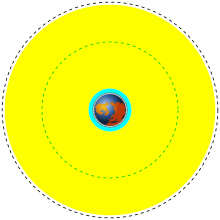
A depression World orbit (LEO) typically is a round orbit near 160 to 2,000 kilometres (99 to i,243 mi) higher up the world's surface and, correspondingly, a period (fourth dimension to revolve around the earth) of about xc minutes.[29]
Because of their low altitude, these satellites are just visible from inside a radius of roughly 1,000 kilometres (620 mi) from the sub-satellite indicate. In addition, satellites in low earth orbit modify their position relative to the ground position apace. And so even for local applications, many satellites are needed if the mission requires uninterrupted connectivity.
Low-World-orbiting satellites are less expensive to launch into orbit than geostationary satellites and, due to proximity to the ground, practise non crave equally high betoken forcefulness (signal forcefulness falls off as the square of the distance from the source, so the effect is considerable). Thus in that location is a merchandise off between the number of satellites and their cost.
In addition, in that location are important differences in the onboard and ground equipment needed to support the two types of missions.
Satellite constellation [edit]
A group of satellites working in concert is known as a satellite constellation. 2 such constellations, intended to provide satellite phone services, primarily to remote areas, are the Iridium and Globalstar systems. The Iridium arrangement has 66 satellites.
It is as well possible to offering discontinuous coverage using a depression-Earth-orbit satellite capable of storing information received while passing over i part of Earth and transmitting it later while passing over another part. This will be the case with the CASCADE system of Canada'due south CASSIOPE communications satellite. Another organisation using this store and forward method is Orbcomm.
Medium Earth orbit (MEO) [edit]
A medium Earth orbit is a satellite in orbit somewhere betwixt 2,000 and 35,786 kilometres (one,243 and 22,236 mi) above the globe's surface. MEO satellites are similar to LEO satellites in functionality. MEO satellites are visible for much longer periods of time than LEO satellites, usually between 2 and 8 hours. MEO satellites have a larger coverage area than LEO satellites. A MEO satellite's longer duration of visibility and wider footprint means fewer satellites are needed in a MEO network than a LEO network. I disadvantage is that a MEO satellite'southward distance gives information technology a longer fourth dimension filibuster and weaker signal than a LEO satellite, although these limitations are not as severe equally those of a GEO satellite.
Similar LEOs, these satellites do non maintain a stationary distance from the earth. This is in contrast to the geostationary orbit, where satellites are always 35,786 kilometres (22,236 mi) from the earth.
Typically the orbit of a medium earth orbit satellite is near 16,000 kilometres (x,000 mi) above world. In various patterns, these satellites make the trip effectually earth in anywhere from 2 to 8 hours.
Examples of MEO [edit]
- In 1962, the communications satellite, Telstar, was launched. It was a medium earth orbit satellite designed to assistance facilitate loftier-speed phone signals. Although information technology was the kickoff practical way to transmit signals over the horizon, its major drawback was before long realised. Considering its orbital flow of virtually 2.5 hours did not match the World'south rotational flow of 24 hours, continuous coverage was impossible. It was credible that multiple MEOs needed to exist used in order to provide continuous coverage.
- In 2013, the first 4 of a constellation of 20 MEO satellites was launched. The O3b satellites provide broadband internet services, in particular to remote locations and maritime and in-flight use, and orbit at an altitude of eight,063 kilometres (five,010 mi)).[thirty]
Geostationary orbit (GEO) [edit]

To an observer on Earth, a satellite in a geostationary orbit appears motionless, in a fixed position in the sky. This is considering it revolves around the Globe at World's own angular velocity (one revolution per sidereal 24-hour interval, in an equatorial orbit).
A geostationary orbit is useful for communications because ground antennas can exist aimed at the satellite without their having to track the satellite'due south movement. This is relatively inexpensive.
In applications that crave many basis antennas, such as DirecTV distribution, the savings in ground equipment can more than outweigh the cost and complexity of placing a satellite into orbit.
Examples of GEO [edit]
- The first geostationary satellite was Syncom iii, launched on August 19, 1964, and used for communication across the Pacific starting with television coverage of the 1964 Summer Olympics. Shortly after Syncom 3, Intelsat I, aka Early Bird, was launched on April 6, 1965, and placed in orbit at 28° west longitude. Information technology was the first geostationary satellite for telecommunications over the Atlantic Ocean.
- On November 9, 1972, Canada's first geostationary satellite serving the continent, Anik A1, was launched by Telesat Canada, with the United states of america following suit with the launch of Westar 1 past Western Union on April 13, 1974.
- On May thirty, 1974, the first geostationary communications satellite in the world to exist iii-axis stabilized was launched: the experimental satellite ATS-6 built for NASA.
- Afterward the launches of the Telstar through Westar 1 satellites, RCA Americom (later GE Americom, now SES) launched Satcom one in 1975. Information technology was Satcom ane that was instrumental in helping early cable TV channels such as WTBS (at present TBS), HBO, CBN (now Freeform) and The Weather Channel go successful, because these channels distributed their programming to all of the local cable Television set headends using the satellite. Additionally, it was the first satellite used by broadcast television networks in the U.s., like ABC, NBC, and CBS, to distribute programming to their local affiliate stations. Satcom 1 was widely used because information technology had twice the communications capacity of the competing Westar 1 in America (24 transponders as opposed to the 12 of Westar 1), resulting in lower transponder-usage costs. Satellites in later decades tended to have fifty-fifty college transponder numbers.
By 2000, Hughes Space and Communications (now Boeing Satellite Development Eye) had built virtually twoscore percent of the more than one hundred satellites in service worldwide. Other major satellite manufacturers include Space Systems/Loral, Orbital Sciences Corporation with the Star Bus series, Indian Space Research Organisation, Lockheed Martin (owns the former RCA Astro Electronics/GE Astro Space business), Northrop Grumman, Alcatel Space, now Thales Alenia Space, with the Spacebus series, and Astrium.
Molniya orbit [edit]
Geostationary satellites must operate above the equator and therefore appear lower on the horizon as the receiver gets farther from the equator. This will cause issues for extreme northerly latitudes, affecting connectivity and causing multipath interference (caused by signals reflecting off the ground and into the ground antenna).
Thus, for areas shut to the N (and South) Pole, a geostationary satellite may announced below the horizon. Therefore, Molniya orbit satellites take been launched, mainly in Russia, to alleviate this problem.
Molniya orbits tin can exist an appealing alternative in such cases. The Molniya orbit is highly inclined, guaranteeing expert elevation over selected positions during the northern portion of the orbit. (Elevation is the extent of the satellite's position in a higher place the horizon. Thus, a satellite at the horizon has zero elevation and a satellite directly overhead has peak of 90 degrees.)
The Molniya orbit is designed so that the satellite spends the great majority of its fourth dimension over the far northern latitudes, during which its ground footprint moves only slightly. Its period is one one-half day, so that the satellite is bachelor for performance over the targeted region for six to nine hours every 2nd revolution. In this way a constellation of three Molniya satellites (plus in-orbit spares) can provide uninterrupted coverage.
The starting time satellite of the Molniya series was launched on Apr 23, 1965 and was used for experimental manual of Boob tube signals from a Moscow uplink station to downlink stations located in Siberia and the Russian Far East, in Norilsk, Khabarovsk, Magadan and Vladivostok. In November 1967 Soviet engineers created a unique system of national TV network of satellite television, called Orbita, that was based on Molniya satellites.
Polar orbit [edit]
In the United States, the National Polar-orbiting Operational Environmental Satellite Arrangement (NPOESS) was established in 1994 to consolidate the polar satellite operations of NASA (National Helmsmanship and Space Administration) NOAA (National Oceanic and Atmospheric Administration). NPOESS manages a number of satellites for various purposes; for example, METSAT for meteorological satellite, EUMETSAT for the European co-operative of the program, and METOP for meteorological operations.
These orbits are sun synchronous, meaning that they cross the equator at the aforementioned local time each day. For case, the satellites in the NPOESS (noncombatant) orbit volition cantankerous the equator, going from south to north, at times 1:30 P.M., 5:30 P.One thousand., and nine:30 P.M.
Structure [edit]
Communications Satellites are normally composed of the following subsystems:
- Communication Payload, unremarkably composed of transponders, antennas, and switching systems
- Engines used to bring the satellite to its desired orbit
- A station keeping tracking and stabilization subsystem used to continue the satellite in the right orbit, with its antennas pointed in the right direction, and its power organisation pointed towards the sun
- Ability subsystem, used to power the Satellite systems, normally equanimous of solar cells, and batteries that maintain ability during solar eclipse
- Command and Control subsystem, which maintains communications with basis control stations. The ground control Earth stations monitor the satellite performance and control its functionality during various phases of its life-cycle.
The bandwidth available from a satellite depends upon the number of transponders provided past the satellite. Each service (Television, Vocalisation, Internet, radio) requires a different amount of bandwidth for manual. This is typically known as link budgeting and a network simulator tin can be used to get in at the verbal value.
Frequency allocation for satellite systems [edit]
Allocating frequencies to satellite services is a complicated process which requires international coordination and planning. This is carried out under the auspices of the International Telecommunications Union (ITU). To facilitate frequency planning, the world is divided into iii regions:
- Region 1: Europe, Africa, the Eye East, what was formerly the Soviet Union, and Mongolia
- Region 2: North and South America and Greenland
- Region 3: Asia (excluding region one areas), Commonwealth of australia, and the southwest Pacific
Inside these regions, frequency bands are allocated to various satellite services, although a given service may exist allocated different frequency bands in different regions. Some of the services provided by satellites are:
- Stock-still satellite service (FSS)
- Dissemination satellite service (BSS)
- Mobile-satellite service
- Radionavigation-satellite service
- Meteorological-satellite service
Applications [edit]
Telephony [edit]
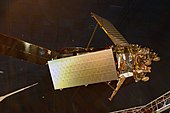
The outset and historically most of import application for communication satellites was in intercontinental long distance telephony. The fixed Public Switched Phone Network relays telephone calls from land line telephones to an globe station, where they are then transmitted to a geostationary satellite. The downlink follows an analogous path. Improvements in submarine communications cables through the use of cobweb-eyes caused some pass up in the employ of satellites for fixed telephony in the belatedly 20th century.
Satellite communications are still used in many applications today. Remote islands such as Ascension Isle, Saint Helena, Diego Garcia, and Easter Island, where no submarine cables are in service, need satellite telephones. There are also regions of some continents and countries where landline telecommunication are rare to nonexistent, for instance big regions of Southward America, Africa, Canada, China, Russian federation, and Australia. Satellite communications likewise provide connexion to the edges of Antarctica and Greenland. Other land use for satellite phones are rigs at body of water, a fill-in for hospitals, armed services, and recreation. Ships at sea, as well as planes, oft employ satellite phones.[31]
Satellite phone systems can be accomplished by a number of means. On a big scale, oft at that place will be a local phone organisation in an isolated expanse with a link to the phone organization in a principal country area. In that location are also services that volition patch a radio signal to a telephone organization. In this case, nearly any type of satellite tin exist used. Satellite phones connect direct to a constellation of either geostationary or low-Globe-orbit satellites. Calls are then forwarded to a satellite teleport continued to the Public Switched Phone Network .
Television [edit]
As television became the main market, its need for simultaneous commitment of relatively few signals of large bandwidth to many receivers existence a more precise match for the capabilities of geosynchronous comsats. Two satellite types are used for Northward American boob tube and radio: Direct broadcast satellite (DBS), and Fixed Service Satellite (FSS).
The definitions of FSS and DBS satellites exterior of North America, peculiarly in Europe, are a bit more than ambiguous. About satellites used for directly-to-home television in Europe accept the aforementioned high power output as DBS-grade satellites in North America, just apply the same linear polarization every bit FSS-class satellites. Examples of these are the Astra, Eutelsat, and Hotbird spacecraft in orbit over the European continent. Because of this, the terms FSS and DBS are more so used throughout the Northward American continent, and are uncommon in Europe.
Fixed Service Satellites use the C band, and the lower portions of the Grandu ring. They are normally used for circulate feeds to and from television networks and local affiliate stations (such as plan feeds for network and syndicated programming, live shots, and backhauls), likewise every bit existence used for distance learning by schools and universities, business boob tube (BTV), Videoconferencing, and full general commercial telecommunication. FSS satellites are also used to distribute national cable channels to cable goggle box headends.
Free-to-air satellite TV channels are too normally distributed on FSS satellites in the Ku band. The Intelsat Americas 5, Galaxy 10R and AMC three satellites over North America provide a quite large corporeality of FTA channels on their Grandu band transponders.
The American Dish Network DBS service has also recently used FSS applied science likewise for their programming packages requiring their SuperDish antenna, due to Dish Network needing more capacity to carry local television receiver stations per the FCC'south "must-bear" regulations, and for more bandwidth to carry HDTV channels.
A direct broadcast satellite is a communications satellite that transmits to small DBS satellite dishes (normally 18 to 24 inches or 45 to 60 cm in bore). Straight broadcast satellites mostly operate in the upper portion of the microwave Ku ring. DBS technology is used for DTH-oriented (Direct-To-Habitation) satellite Idiot box services, such as DirecTV, DISH Network and Orby TV[32] in the United States, Bell Satellite TV and Shaw Directly in Canada, Freesat and Heaven in the Britain, Ireland, and New Zealand and DSTV in South Africa.
Operating at lower frequency and lower power than DBS, FSS satellites crave a much larger dish for reception (3 to viii feet (1 to two.5 m) in bore for Ku band, and 12 feet (3.half-dozen m) or larger for C ring). They use linear polarization for each of the transponders' RF input and output (equally opposed to circular polarization used by DBS satellites), just this is a minor technical difference that users exercise not notice. FSS satellite engineering science was likewise originally used for DTH satellite Television from the tardily 1970s to the early 1990s in the Usa in the class of TVRO (TeleVision Receive Only) receivers and dishes. It was also used in its Ku ring form for the now-defunct Primestar satellite TV service.
Some satellites have been launched that have transponders in the Ka ring, such as DirecTV's SPACEWAY-1 satellite, and Anik F2. NASA and ISRO[33] [34] have besides launched experimental satellites carrying Yarda band beacons recently.[35]
Some manufacturers accept besides introduced special antennas for mobile reception of DBS television. Using Global Positioning System (GPS) technology equally a reference, these antennas automatically re-aim to the satellite no matter where or how the vehicle (on which the antenna is mounted) is situated. These mobile satellite antennas are pop with some recreational vehicle owners. Such mobile DBS antennas are also used by JetBlue Airways for DirecTV (supplied by LiveTV, a subsidiary of JetBlue), which passengers tin can view on-board on LCD screens mounted in the seats.
Radio broadcasting [edit]
Satellite radio offers sound broadcast services in some countries, notably the Usa. Mobile services allow listeners to roam a continent, listening to the same audio programming anywhere.
A satellite radio or subscription radio (SR) is a digital radio signal that is circulate by a communications satellite, which covers a much wider geographical range than terrestrial radio signals.
Satellite radio offers a meaningful alternative to footing-based radio services in some countries, notably the U.s.. Mobile services, such every bit SiriusXM, and Worldspace, allow listeners to roam across an entire continent, listening to the same audio programming anywhere they go. Other services, such as Music Choice or Muzak's satellite-delivered content, require a fixed-location receiver and a dish antenna. In all cases, the antenna must have a clear view to the satellites. In areas where alpine buildings, bridges, or even parking garages obscure the bespeak, repeaters can exist placed to make the signal available to listeners.
Initially bachelor for circulate to stationary Goggle box receivers, past 2004 popular mobile direct broadcast applications made their advent with the arrival of two satellite radio systems in the United states of america: Sirius and XM Satellite Radio Holdings. Later on they merged to go the conglomerate SiriusXM.
Radio services are usually provided by commercial ventures and are subscription-based. The various services are proprietary signals, requiring specialized hardware for decoding and playback. Providers unremarkably deport a variety of news, conditions, sports, and music channels, with the music channels more often than not being commercial-complimentary.
In areas with a relatively high population density, it is easier and less expensive to accomplish the majority of the population with terrestrial broadcasts. Thus in the United kingdom of great britain and northern ireland and some other countries, the contemporary development of radio services is focused on Digital Audio Dissemination (DAB) services or Hard disk drive Radio, rather than satellite radio.
Apprentice radio [edit]
Amateur radio operators have access to amateur satellites, which accept been designed specifically to carry amateur radio traffic. Most such satellites operate as spaceborne repeaters, and are generally accessed by amateurs equipped with UHF or VHF radio equipment and highly directional antennas such as Yagis or dish antennas. Due to launch costs, most current amateur satellites are launched into fairly depression World orbits, and are designed to bargain with only a limited number of brief contacts at any given time. Some satellites likewise provide data-forwarding services using the X.25 or similar protocols.
Internet access [edit]
Later the 1990s, satellite communication technology has been used as a means to connect to the Internet via broadband data connections. This tin exist very useful for users who are located in remote areas, and cannot access a broadband connection, or require high availability of services.
Military [edit]
Communications satellites are used for armed forces communications applications, such as Global Command and Control Systems. Examples of armed forces systems that utilize advice satellites are the MILSTAR, the DSCS, and the FLTSATCOM of the United States, NATO satellites, Britain satellites (for instance Skynet), and satellites of the quondam Soviet Union. India has launched its offset Military Communication satellite GSAT-7, its transponders operate in UHF, F, C and Mu ring bands.[36] Typically military machine satellites operate in the UHF, SHF (besides known as X-ring) or EHF (also known as Thousanda band) frequency bands.
Data collection [edit]
Near-ground in situ ecology monitoring equipment (such equally weather stations, weather buoys, and radiosondes), may use satellites for ane-mode data transmission or two-fashion telemetry and telecontrol.[37] [38] It may be based on a secondary payload of a weather satellite (as in the instance of GOES and METEOSAT and others in the Argos system) or in dedicated satellites (such equally SCD). The data charge per unit is typically much lower than in satellite Internet access.
See also [edit]
- Commercialization of infinite
- History of telecommunications
- Inter-satellite communications satellite
- Listing of communication satellite companies
- List of communications satellite firsts
- NewSpace
- Reconnaissance satellite
- Relay (disambiguation)
- Satcom On The Move
- Satellite data unit
- Satellite filibuster
- Satellite space segment
- Space pollution
References [edit]
Notes [edit]
- ^ Orbital periods and speeds are calculated using the relations 4π2 R 3 =T two GM and Five 2 R =GM, where R is the radius of orbit in metres; T is the orbital period in seconds; V is the orbital speed in m/south; Thousand is the gravitational abiding, approximately half-dozen.673×10−11 Nm2/kg2 ; 1000 is the mass of Earth, approximately 5.98×1024 kg (1.318×ten25 lb).
- ^ Approximately 8.6 times (in radius and length) when the Moon is nearest (that is, 363,104 km / 42,164 km ), to 9.6 times when the Moon is uttermost (that is, 405,696 km / 42,164 km ).
Citations [edit]
- ^ Labrador, Virgil (2015-02-xix). "satellite advice". Britannica.com . Retrieved 2016-02-10 .
- ^ "UCS Satellite Database". Union of Concerned Scientists. 1 August 2020. Retrieved 2 Jan 2021.
- ^ "Satellites - Communication Satellites". Satellites.spacesim.org. Retrieved 2016-02-10 .
- ^ a b "Military Satellite Communications Fundamentals | The Aerospace Corporation". Aerospace. 2010-04-01. Archived from the original on 2015-09-05. Retrieved 2016-02-10 .
- ^ Arthur C. Clarke (October 1945). "Extraterrestrial Relays: Tin Rocket Stations Give World-wide Radio Coverage?" (PDF). Arthur C. Clarke Institute for Space Pedagogy. Retrieved 1 January 2021.
- ^ Mike Mills (three August 1997). "Orbit Wars". The Washington Post . Retrieved ane January 2021.
- ^ Asif Siddiqi (November 2007). "The Human Behind the Curtain". Air & Space Magazine. Retrieved 1 Jan 2021.
- ^ Anatoly Zak (2017). "Design of the first artificial satellite of the Earth". RussianSpaceWeb.com. Retrieved 1 Jan 2021.
- ^ van Keuren, David K. (1997). "Chapter two: Moon in Their Eyes: Moon Communication Relay at the Naval Enquiry Laboratory, 1951-1962". In Butrica, Andrew J (ed.). Beyond The Ionosphere: Fifty Years of Satellite Communication. NASA History Office. Bibcode:1997bify.book.....B.
- ^ Martin, Donald; Anderson, Paul; Bartamian, Lucy (March 16, 2007). Communications Satellites: Project SCORE (5th ed.). AIAA. ISBN978-1884989193.
- ^ "U.s.a. Helmsmanship and Space Activities - 1st Annual Report to Congress" (PDF). Published as House Certificate Number 71, 86th Congress, 1st Session. The White Firm. two February 1959. pp. 13–fourteen. Retrieved two January 2021.
- ^ "Courier 1B". NASA. 2020. Retrieved 3 Jan 2021.
- ^ a b "Usa Helmsmanship and Infinite Activities 1960" (PDF). The White House. xviii January 1961. pp. 12–xiii, 26. Retrieved 3 January 2021.
- ^ "Echo 1". NASA. 2020. Retrieved 3 January 2021.
- ^ Martin, Donald; Anderson, Paul; Bartamian, Lucy (March 16, 2007). Communications Satellites: Telstar (fifth ed.). AIAA. ISBN978-1884989193.
- ^ "U.s.a. Aeronautics and Space Activities 1962" (PDF). The White House. 28 January 1963. pp. 20, 96. Retrieved 3 January 2021.
- ^ a b Ward, William West.; Floyd, Franklin Due west. (1997). "Chapter 8: 30 Years of Infinite Communications Research and Development at Lincoln Laboratory". In Butrica, Andrew J (ed.). Beyond The Ionosphere: 50 Years of Satellite Communication. NASA History Office. Bibcode:1997bify.book.....B.
- ^ "Project W Ford". NASA. Retrieved iv January 2021.
- ^ "NASA Compendium Of Satellite Communications Programs" (PDF). NASA. December 1975. pp. 5-1 to 5-xvi. Retrieved 4 January 2021.
- ^ "Syncom 2". NASA. Retrieved 3 January 2021.
- ^ "Syncom 3". NASA. Retrieved 3 January 2021.
- ^ "LES ane". NASA. Retrieved 4 January 2021.
- ^ "NASA Compendium Of Satellite Communications Programs" (PDF). NASA. December 1975. pp. nine-1 to ix-56. Retrieved four January 2021.
- ^ a b c Pelton, Joseph N. (2015). "History of Satellite Communications". In Pelton J.; Madry South.; Camacho-Lara S. (eds.). Handbook of Satellite Applications. New York: Springer. Bibcode:2017hsa..book.....P.
- ^ "Early Bird". NASA. Retrieved five January 2021.
- ^ "NASA Compendium Of Satellite Communications Programs" (PDF). NASA. Dec 1975. pp. 10-1 to x-64. Retrieved 5 Jan 2021.
- ^ "Molniya i-ane". NASA. Retrieved five January 2021.
- ^ Altshuler, José (1997). "Chapter 18: From Shortwave and Besprinkle to Satellite: Cuba's International Communications". In Butrica, Andrew J (ed.). Beyond The Ionosphere: Fifty Years of Satellite Advice. NASA History Office. Bibcode:1997bify.book.....B.
- ^ "IADC Space Droppings Mitigation Guidelines" (PDF). INTER-Agency SPACE DEBRIS COORDINATION Commission: Issued by Steering Group and Working Group four. September 2007.
Region A, Low Earth Orbit (or LEO) Region – spherical region that extends from the Earth's surface upwards to an altitude (Z) of two,000 km
- ^ "Soyuz Flight VS05 Launch Kit" (PDF). Arianespace. June 1, 2013. Retrieved 27 August 2020.
- ^ "Continued:Maritime". Iridium. Archived from the original on 2013-08-15. Retrieved 2013-09-nineteen .
- ^ "Orby Television (United States)". Retrieved 9 April 2020.
- ^ "GSAT-14". ISRO. Archived from the original on 8 January 2014. Retrieved xvi January 2014.
- ^ "Indian GSLV successfully lofts GSAT-14 satellite". NASA Space Flight. 4 January 2014. Retrieved 16 January 2014.
- ^ "DIRECTV's Spaceway F1 Satellite Launches New Era in Loftier-Definition Programming; Next Generation Satellite Will Initiate Historic Expansion of DIRECTV". SpaceRef. Retrieved 2012-05-xi .
- ^ "India's outset 'military' satellite GSAT-7 put into earth's orbit". NDTV.com. 2013-09-04. Retrieved 2013-09-18 .
- ^ Kramer, Herbert J. (2002). "Data Collection (Messaging) Systems". Observation of the Earth and Its Environment. Berlin, Heidelberg: Springer Berlin Heidelberg. pp. 311–328. doi:10.1007/978-three-642-56294-5_4. ISBN978-three-642-62688-3.
- ^ "Satellite Data Telecommunication Handbook". library.wmo.int . Retrieved 2020-12-21 .
External links [edit]
- Satellite Manufacture Clan
- European Satellite Operators Association
- Satellite Glossary
- SatMagazine
- SatNews
- The time to come of communication satellite business
- Communications satellites short history by David J. Whalen
- Beyond The Ionosphere: Fifty Years of Satellite Communication (NASA SP-4217, 1997)
Source: https://en.wikipedia.org/wiki/Communications_satellite
Belum ada Komentar untuk "True or False The Upload and Download Signals for Satellites Are Transmitted at the Same Frequency"
Posting Komentar